Ball-point Pens and Why I Became an Evil Wizard
2026-08-27
Text editors are like pens; I use my favorite and maintain a backup. With tools, a constant and reliable instrument can be clunky unpleasant to use. On the other hand, a tool with more positive affect is often more temperamental. It's also important not to place tool preference at the exclusion of common standards.
My analog text editor of choice is my Lamy fountain pen. It requires less pressure to write than a ball-point. Weighing 24 grams, it has a pleasant heft compared to a Pilot V7. Most disposable ball-points weigh under 20 grams. It's a refillable, maintainable environmentally friendly writing machine. Take care of a good fountain pen and it will take care of you forever.
Fountain pens will also run out of ink abruptly.
I keep my pen in my pocket but a ball-point in my backpack.
That means there's a beta mode available with a low-friction switch,
just holster the Lamy and continue with pilot.
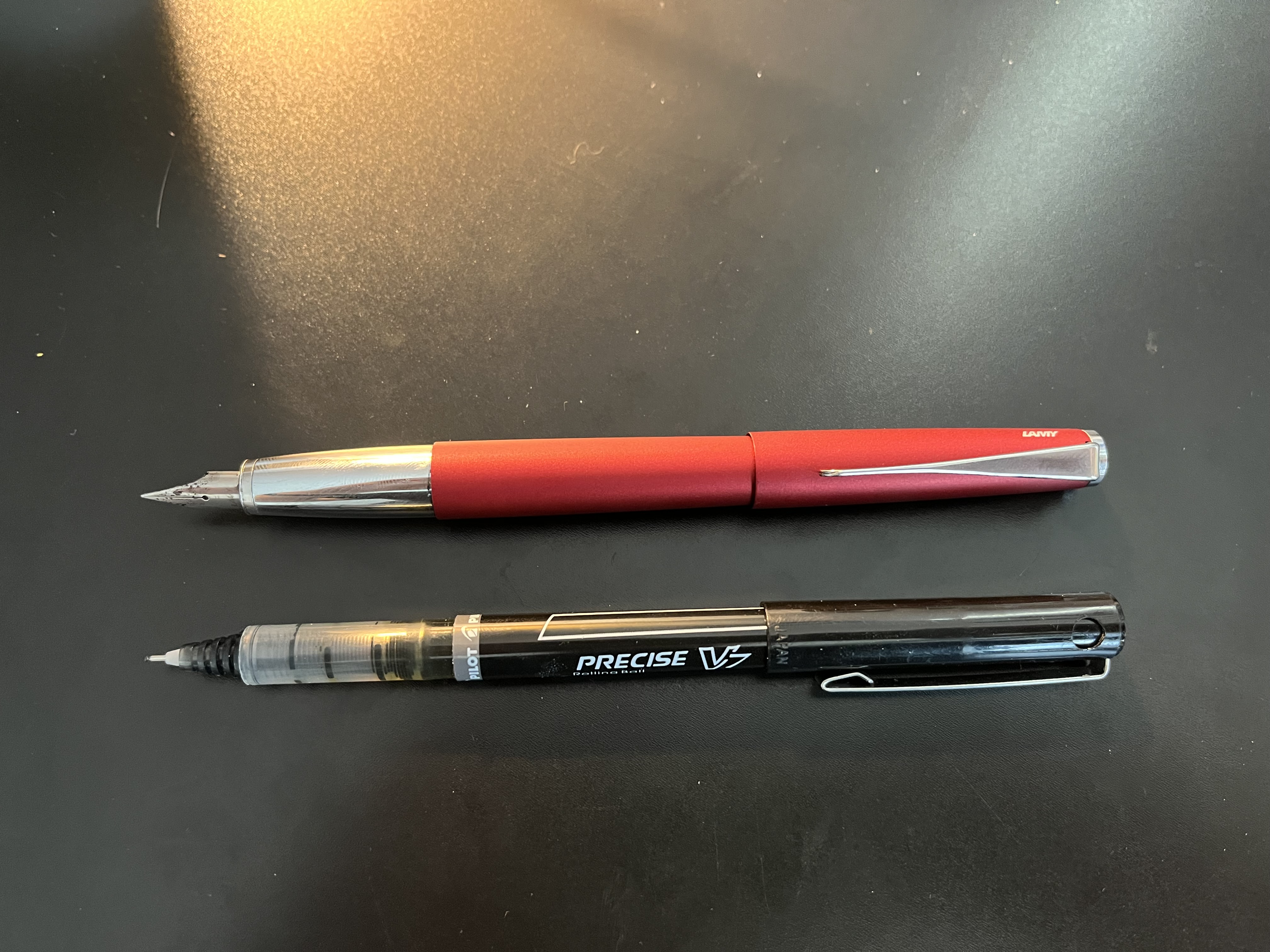
Plus, if someone needs to borrow a pen, I can give them my tractable, fungible ball-point. (todo, check usage) Fountain pens aren't in common use; not everybody's familiar with them. Hand a someone a ball-point and they'll write something down. Hand them a fountain pen and they'll pause as if they don't know how to operate the foreign object. In addition to avoiding friction from an adoption barrier I also want to protect my assets; there's also the possibility that someone might walk away with the pen I hand them.
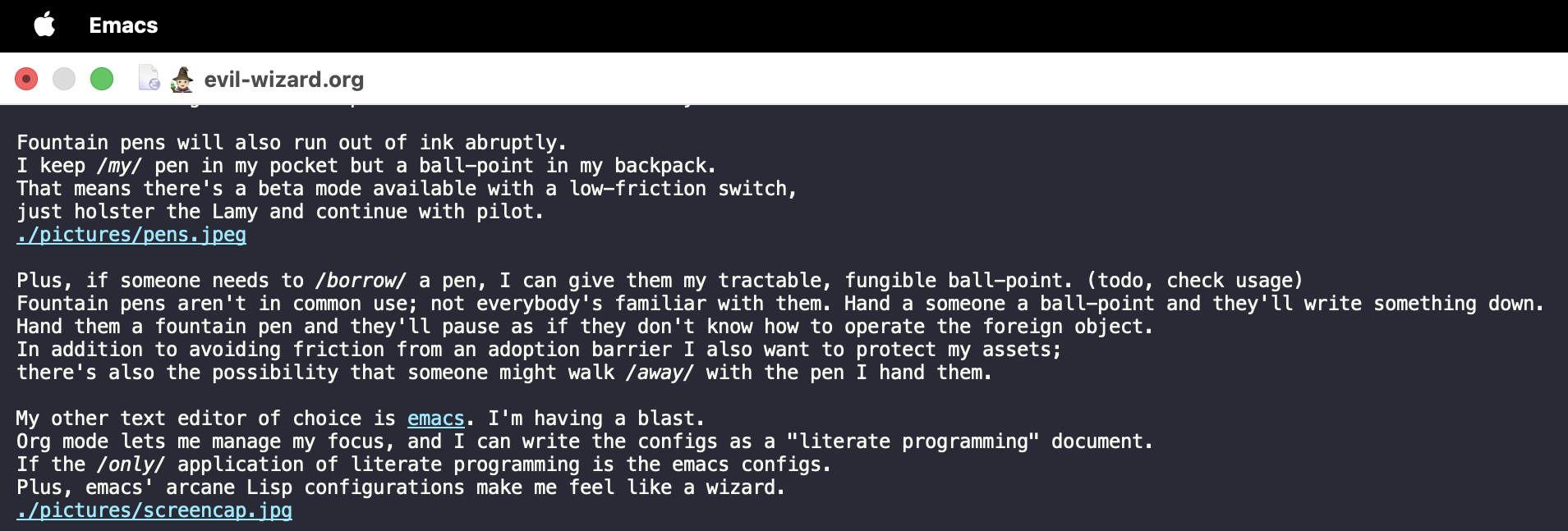
My other text editor of choice is emacs. I'm having a blast.
Org mode lets me manage my focus, and I can write the configs as a "literate programming" document.
If the only application of literate programming is the emacs configs.
Plus, emacs' arcane Lisp configurations make me feel like a wizard.
I learned vim first.
It's easy to keep a copy of vim on your system. First off, because it's very resource efficient, second because it's probably already there. Unix-like systems (including Linux, MacOs and Android) already come with vim installed.
It's also hard to learn.
Vim uses keyboard shortcuts (or "motions") as the primary control mechanism.
The motions get into your fingers, like piano scales or Street Fighter combos.
After I die, I'll probably still be tapping :wq on the door of my coffin.
Emacs also relies on keyboard motions, emacs and vim motions are wildly different.
On day 1 of using emacs, I could log in, but I couldn't exit out (C-c C-x by the way).
Fortunately, Emacs supports vim motions with the plugin "evil-mode".
Using vim mode on an editor is more than a personal convenience. By keeping the vim skill set alive, I have access to a consistent, , low-overhead backup text editor. Because of vim/vi's ubiquity and low profile, vim motions are a lingua franca of the terminal. This makes it much more likely for me to run into other vim users than Emacs users. In a collaborative workspace, it's impractical to maintain an editor that uses emacs-only motions; It's like handing a coworker a pen that they don't know how to use.
I use Emacs, which makes me a wizard. And I use it in evil mode which makes me an evil wizard. 🧙🏻